
Why Slack and Microsoft Teams Are Not Built for Marketing Approvals: The Risks for Marketing Teams in Regulated Industries
Jodie Byass
Published: 25 June 2026
Share


Why Slack and MS Teams Are Not Built for Marketing Approvals
No. Slack and Microsoft Teams are not suitable for managing marketing approvals in regulated industries. Both platforms were designed for real-time team messaging — not structured approval workflows, visual proofing of creative assets, or regulatory-grade audit trails. Marketing teams using them for approvals face five critical gaps: no visual proofing capability, no structured sign-off workflows, no defensible audit trail, poor version control, and significant compliance exposure.
Purpose-built approval workflow software like Admation is designed specifically to solve these problems for marketing and creative teams.
Slack and Microsoft Teams have become the default communication layer for most marketing teams. They are fast, familiar, and genuinely useful — for messaging. But marketing teams in regulated industries increasingly rely on them for something they were never designed to do: managing creative approvals, reviewing artwork and brand assets, and maintaining the compliance records that regulators require.
This article examines exactly why these chat tools fall short as marketing approval workflow software, the specific operational and compliance risks they introduce, and what purpose-built creative approval software provides instead.
How Slack and Teams Compare to Purpose-Built Approval Workflow Software
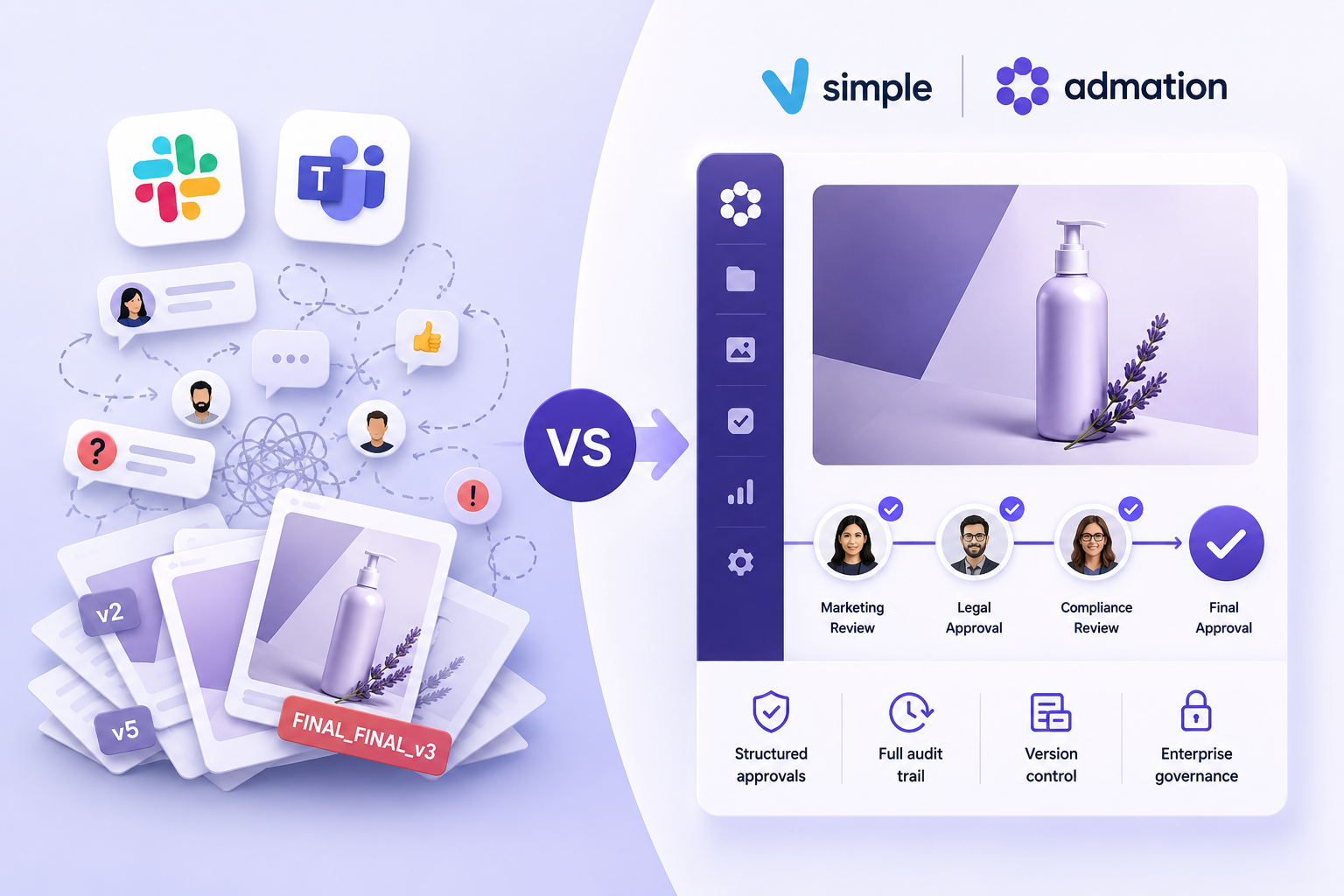
Across every capability that matters for marketing approvals, Slack and Microsoft Teams fall short of what purpose-built platforms provide. Neither offers visual proofing or artwork annotation tools. Slack has no structured approval workflows at all; Teams offers only a basic Approvals app. For audit trails, Slack provides message history subject to retention limits, while Teams offers communication compliance through Purview — but neither produces the marketing-specific compliance documentation that regulated industries require. Version control in Slack is limited to file attachments with no versioning; Teams relies on SharePoint versioning at the document level only, not tied to approval decisions. Feedback in both platforms is fragmented across threads, channels, and DMs with no consolidated view. Neither platform has meaningful approval escalation or reminder capability. And on regulatory compliance documentation, Slack is not suitable at all; Teams provides only partial support that falls short of marketing compliance standards. A purpose-built platform like Admation addresses all of these gaps out-of-the-box.
What Does a Proper Marketing Approval Process Require?
Before examining where Slack and Teams fall short, it helps to be clear about what rigorous marketing approval management actually demands — particularly in financial services, banking, insurance, healthcare, and other regulated sectors.
Effective marketing review and approval processes require four core capabilities. First, visual proofing: the ability for reviewers to annotate directly on creative assets — PDFs, digital banners, video storyboards, product brochures — within a single platform. Second, structured multi-stakeholder approval workflows: defined sign-off sequences that enforce who reviews content, in what order, and prevent content from progressing without required authorisations. Third, comprehensive audit trails: immutable, time-stamped records that document who reviewed which version of an asset, when, what feedback was provided, and who gave final approval — exportable for regulatory review. Fourth, version control designed for creative assets: a system that tracks every iteration of artwork and ties approval decisions to specific versions.
Chat platforms deliver none of these reliably. That is not a criticism of what they do well — it is simply a recognition that they were built for a different job.
The core problem is not that Slack or Teams are poor tools. It is that they are the wrong tool for a job with real regulatory, operational, and brand consequences.
Can Slack Be Used for Marketing Approvals?
What Slack Does Well
Slack is an excellent real-time communication platform. Its channel structure, search functionality, and integrations ecosystem make it genuinely valuable for day-to-day marketing team coordination: quick questions, project updates, and keeping stakeholders informed. For that purpose, it belongs in the marketing technology stack.
The problems begin when teams start using it as a substitute for purpose-built creative approval software.
Critical Gap 1: No Visual Proofing or Artwork Annotation
Slack allows files to be shared in channels and DMs, and reviewers can respond with text comments in the thread. This is file sharing with adjacent commentary — it is not online proofing.
When a designer shares a 12-page product brochure or a complex digital advertisement in Slack, reviewers must download the file, open it in a separate application, note their feedback, and return to Slack to type it up. There is no mechanism to annotate directly on the artwork, circle a specific design element, or highlight a section of copy. Feedback such as 'the logo on page three needs repositioning' is imprecise without visual context. The result is ambiguous instructions, extended revision cycles, and creative teams spending significant time interpreting comments rather than acting on them. Purpose-built online proofing tools eliminate this entirely.
Critical Gap 2: No Structured Approval Workflow Software
In Slack, an 'approval' is a message in a thread, an emoji reaction, or a reply saying 'looks good.' There is no native mechanism to define an approval sequence, enforce sign-off order, or gate content from progressing until all required stakeholders have responded. This is what approval workflow software is specifically designed to provide.
Consider a financial services organisation where marketing content requires sign-off from the brand team, then the product team, then legal, then the Chief Marketing Officer. In Slack, managing this sequence means manually tracking who has responded, following up individually with those who have not, and hoping nothing slips through. There is no system-enforced workflow, no escalation when an approval is overdue, and no gate preventing content from being published before legal has reviewed it.
Teams compensate by building manual trackers in spreadsheets alongside their Slack conversations — a workaround that creates two sources of truth, eliminates visibility, and compounds compliance risk.
Critical Gap 3: No Defensible Audit Trail for Marketing Compliance
This is where organisations in regulated industries face their most serious exposure. Slack messages are conversational records, not compliance documentation. While Slack retains message history subject to plan limits and retention policies, it does not produce a structured, immutable record of marketing approval decisions in a format suitable for regulatory review. This is a fundamental difference from dedicated marketing compliance software.
When an auditor asks a financial services firm to demonstrate that their Q3 advertising campaign was reviewed and approved by their compliance team before publication, a Slack thread is not a defensible response. Messages can be deleted. Reactions can be removed. Threads can be archived. And Slack's standard retention policies may not align with the five-to-seven year record-keeping requirements of many regulated industries. Even where messages are retained, reconstructing a coherent approval history from fragmented threads across multiple channels and DMs is labour-intensive with no guarantee of completeness.
Critical Gap 4: Version Control Chaos for Creative Assets
Creative assets in Slack exist as file attachments to messages. When a designer uploads a revised version, it appears as a new file in the thread — but the earlier version remains accessible above it. Stakeholders in different time zones may download and review the wrong version. Feedback may be provided on an outdated file. Approvals may be given for content that is then revised further before publication. Proper version control in purpose-built platforms ties approval records to specific asset versions, eliminating this ambiguity entirely.
Critical Gap 5: Fragmented Feedback With No Consolidated View
In a typical Slack approval scenario, feedback arrives from multiple reviewers across different threads, DMs, and channels. One stakeholder replies in the channel thread. Another sends a DM directly to the designer. A third posts comments in a separate project channel. Creative teams must manually collate this fragmented feedback, reconcile conflicting instructions, and make judgement calls about which comments take precedence. There is no single consolidated view of all feedback on a piece of content — one of the most fundamental features of purpose-built creative approval software.
Is Microsoft Teams Suitable for Managing Creative Approvals?
What Teams Does Well
Microsoft Teams offers a more structured environment than Slack within the Microsoft 365 ecosystem. Its integration with SharePoint, OneDrive, and the broader Office suite makes it a natural home for document co-authoring and team communication. For organisations already embedded in the Microsoft stack, Teams provides genuine value as a collaboration platform.
But co-authoring documents and managing regulated marketing approvals are fundamentally different activities. Teams, like Slack, was not built for the latter.
The SharePoint File Problem
Teams handles file management through SharePoint document libraries, which is more organised than Slack's attachment-in-thread approach. However, SharePoint version control — while functional for document editing — does not constitute a marketing approval audit trail. SharePoint can record that a file was modified on a given date by a given user. It cannot document that the Head of Compliance reviewed version three of a campaign advertisement, requested two changes, reviewed version four, and formally approved it on a specific date under their delegated authority.
That distinction matters enormously in a regulatory context — and it is precisely what marketing compliance software is built to capture.
The Teams Approvals App: A Partial Solution With Significant Limitations
Microsoft Teams includes a native Approvals app that allows users to create basic approval requests within Teams channels. For simple, low-stakes approvals — expense requests, leave forms, minor internal documents — it can be serviceable.
For marketing content approvals in regulated industries, it falls significantly short. The Approvals app supports basic approve/reject decisions but lacks visual proofing capability, cannot enforce complex multi-tier approval sequences with conditional logic, does not produce regulatory-grade marketing compliance documentation, and has no concept of version-controlled creative assets. It is a lightweight tool layered onto a messaging platform — not a substitute for dedicated approval workflow software.
The Notification and Attention Problem
Both Slack and Teams share a structural problem particularly acute for approval workflows: they compete for attention in the same space as everything else. In a busy Teams environment, an approval request arrives in the same channel as project updates, meeting notifications, casual conversation, and system alerts. Urgent approval requests get buried. Stakeholders miss their cue. Deadlines slip.
Purpose-built marketing approval platforms send targeted notifications tied specifically to individual approval tasks, with automated escalation to managers when deadlines are missed and clear dashboards showing outstanding approvals across all active campaigns. The signal-to-noise ratio is fundamentally different.
Compliance and Governance in Regulated Industries
Microsoft Teams offers compliance features through Microsoft Purview — including eDiscovery, communication compliance policies, and retention labels. Organisations that have properly configured these tools have a more defensible position than those relying on Slack's basic retention.
However, even with Purview enabled, Teams does not produce marketing-specific approval documentation. It can preserve communication records. It cannot generate a structured approval report showing the complete content review history for a specific campaign asset, with version history, reviewer identities and roles, approval timestamps, feedback records, and final sign-off confirmation. That is the structure that marketing compliance audits require — and it is what purpose-built software delivers automatically.
What Are the Risks of Using Chat Tools for Marketing Approvals?
Regulatory Compliance Exposure
For organisations in financial services, banking, insurance, healthcare, and pharmaceuticals, marketing content is subject to regulatory oversight. Regulators and internal audit teams require evidence that marketing content was properly reviewed, approved by appropriately authorised personnel, and compliant with relevant rules before publication.
A reconstructed Slack thread or a Teams message history is unlikely to satisfy that standard. The inability to produce complete, structured, immutable approval records is a compliance finding — and in some cases, a regulatory breach. The cost of a regulatory finding — remediation, potential fines, management time, and reputational damage — vastly exceeds the investment in purpose-built marketing compliance software.
Brand and Approval Integrity Risks
Without a structured approval gate, content can move to publication before it has received all required sign-offs. In a fragmented chat environment, it is easy for a designer to misread a partial approval as a full one, for an emoji reaction to be interpreted as sign-off when it was meant as acknowledgement, or for a final version to be published before legal has completed their review.
These are not hypothetical scenarios — they are common failure modes in organisations relying on chat tools for artwork approval and creative sign-off. Brand incidents, regulatory breaches, and legal exposure can all result from content published without complete authorisation.
Operational Inefficiency and Hidden Costs
Approval cycles managed through unstructured tools run 25 to 40% longer than those using purpose-built platforms. The time cost accumulates across every campaign: creative teams chasing feedback, project managers maintaining parallel spreadsheet trackers, stakeholders being followed up repeatedly because their initial response was missed in a busy channel.
The hidden operational cost of chat-based approval management — in staff time, extended campaign timelines, and delayed time-to-market — is rarely calculated but consistently significant.
Knowledge Loss and Institutional Memory
When creative feedback and approval decisions live in Slack channels and Teams threads, they are effectively invisible beyond a narrow window of time. A designer who needs to understand why a specific design decision was made six months ago cannot easily retrieve that context. An organisation facing a compliance audit in three years cannot reconstruct the approval history of a campaign from ephemeral chat records. Purpose-built creative approval software creates a permanent, searchable record of every decision — genuine institutional knowledge.
Where Slack and Teams Do Belong in the Marketing Stack
The answer is not to remove Slack or Teams from the marketing team's toolkit. Both platforms deliver real value for their intended purpose: rapid communication, project coordination, and the informal conversation that keeps teams connected.
The answer is to stop asking them to manage something they were never designed to handle. The most effective marketing operations teams maintain a clear separation between their communication layer — where Slack and Teams belong — and their approval and workflow layer, where purpose-built software is required.
Integration between the two is the right model. Slack or Teams handles day-to-day coordination. A dedicated platform manages structured approval workflows, visual proofing, version control, and compliance documentation. Triggered notifications in Slack or Teams when an approval task is ready give teams the best of both worlds — without the compliance and operational risks of conflating them.
How Purpose-Built Approval Workflow Software Closes the Gaps
Built-In Online Proofing Tools
Online proofing software purpose-built for marketing allows reviewers to annotate directly on creative assets — marking up specific elements, highlighting copy, drawing attention to design issues — within the platform itself. Feedback is precise, visual, and contextual. Side-by-side version comparison shows exactly what changed between revision rounds. All feedback is consolidated in a single view, eliminating the fragmentation that defines chat-based review.
Configurable Multi-Stakeholder Approval Workflows
Dedicated marketing approval workflow software provides configurable approval pathways built for the complexity of regulated marketing environments. Sequential approvals are enforced by the system — legal cannot be bypassed. Parallel approvals allow multiple stakeholders to review simultaneously. Conditional logic routes content to additional approvers based on content type, budget thresholds, or market-specific requirements. Escalation rules automatically notify managers when approvals are overdue. None of this is achievable in a chat platform without significant manual workarounds.
Regulatory-Grade Audit Trails for Marketing Compliance
Every action in a purpose-built approval system is automatically documented: who created the brief, who submitted content for review, who reviewed it and when, what feedback was provided, what version was approved, and under what authority. These records are immutable, time-stamped, and exportable in formats suitable for regulatory review. When an auditor requests evidence of marketing compliance, the documentation is complete and immediately accessible — not reconstructed from chat history.
Version Control Designed for Artwork and Creative Assets
Version control in purpose-built platforms is designed around the creative review cycle. When a new version of an asset is uploaded, previous versions are clearly superseded and archived. Reviewers always work from the current version. Approval history is attached to specific versions, creating a clear lineage from brief through to final approved artwork. There is no ambiguity about what was approved, in what form, and by whom.
Integrated Digital Asset Management
Beyond the approval workflow, purpose-built platforms provide centralised asset libraries with rich metadata, advanced search, rights and licence management, and brand consistency controls — a fully integrated digital asset management solution. Approved assets are accessible in a controlled environment. Unapproved or outdated versions are not. This eliminates the risk of teams inadvertently working from or publishing superseded brand materials.
The Business Case for Purpose-Built Creative Approval Software
The investment in dedicated marketing approval workflow software is consistently justified by measurable returns. Organisations that transition from chat-based approval management to purpose-built platforms typically achieve a 20 to 30% reduction in approval cycle times, enabling faster campaign launches. Audit preparation time falls by up to 70% when compliance documentation is automatically generated rather than manually reconstructed. Creative team productivity improves by 15 to 25% as time spent chasing approvals and interpreting ambiguous feedback is redirected to creative work.
Beyond the quantifiable efficiency gains, the risk reduction is significant. A single regulatory finding related to inadequate marketing approval documentation can generate costs — in remediation, management time, and potential fines — that dwarf years of investment in a compliant approval system. For organisations in financial services, insurance, healthcare, and pharmaceuticals, this is not a theoretical risk.
The Bottom Line: Right Tool, Right Job
Slack and Microsoft Teams are genuinely valuable platforms that belong in the marketing team's technology stack. But using them to manage creative approvals, artwork review, version-controlled asset sign-off, and regulatory compliance documentation is asking them to do something they were never designed to do.
The consequences — fragmented feedback, missed approvals, inadequate audit trails, compliance exposure, and extended campaign timelines — are predictable and preventable. Marketing teams, particularly those in regulated industries, need tools designed specifically for the complexity and compliance requirements of their work. Which is why regulated teams move approvals onto purpose-built marketing compliance software instead.
Purpose-built marketing approval software like Admation delivers what chat platforms cannot: online proofing tools for artwork annotation, structured approval workflow software, regulatory-grade audit trails, version control designed for creative assets, and integrated digital asset management — all out-of-the-box, without workarounds, manual tracking, or compliance compromise.
Transform Your Marketing Approvals with Admation
Admation is purpose-built marketing project management and approval workflow software designed for marketing teams in regulated industries. Streamline creative approvals, strengthen regulatory compliance, eliminate the operational risks of chat-based review, and give legal and compliance teams the structured sign-off process they need — all in one platform.
Request a demo at simple.io to see how leading marketing teams manage creative workflows and maintain compliance.
Frequently Asked Questions
Can Slack be used for marketing approvals?
Slack can be used to share files and gather informal feedback, but it is not suitable for formal marketing approvals in regulated industries. It lacks visual proofing tools for artwork annotation, structured approval workflows to enforce sign-off sequences, regulatory-grade audit trails, and version control designed for creative assets. Marketing teams using Slack for approvals face compliance exposure, operational inefficiency, and significant audit risk.
Is Microsoft Teams suitable for managing creative approvals?
Microsoft Teams is not suitable as a standalone creative approval platform. While it offers more structure than Slack — particularly through SharePoint integration — it lacks visual proofing capability and does not produce the marketing-specific compliance documentation that regulated industries require. The native Approvals app handles simple decisions but cannot manage complex multi-tier creative workflows. Organisations in financial services, banking, insurance, or healthcare need purpose-built approval workflow software.
What should marketing teams use instead of Slack for approvals?
Marketing teams should use dedicated approval workflow software that provides online proofing tools for artwork annotation, configurable multi-stakeholder approval pathways, immutable audit trails for compliance, and version control tied to specific asset versions. Purpose-built platforms like Admation are designed specifically for these requirements and integrate with communication tools like Slack and Teams for notifications — without using them as the approval system itself.
What is wrong with using Slack emoji reactions as approvals?
Emoji reactions in Slack are not auditable approval records. They can be added or removed by any user, there is no confirmation of what was reviewed or approved, there is no record of who held the authority to approve the content, and they provide no evidence suitable for regulatory review. In a compliance audit, a thumbs-up reaction on a Slack message is not a defensible approval record.
How do financial services marketing teams manage compliance?
Marketing teams in financial services and other regulated industries require a purpose-built marketing compliance software platform that provides immutable audit trails documenting every review action, version-controlled creative asset management, configurable multi-stakeholder approval workflows with enforced sign-off sequences, and compliance reporting exportable for regulatory review. Chat platforms and general-purpose project management tools cannot reliably deliver these requirements. Purpose-built solutions like Admation are specifically designed for compliance-heavy marketing environments.
What are the risks of using chat tools for creative approvals?
The key risks include regulatory compliance exposure from inadequate approval documentation, brand and approval integrity failures when content is published without complete sign-off, operational inefficiency from approval cycles running 25 to 40% longer than purpose-built systems, and institutional knowledge loss when decisions made in chat threads become inaccessible over time. For regulated industries, the compliance exposure alone justifies investment in dedicated creative approval software.
How much does it cost to implement marketing approval workflow software?
Purpose-built marketing approval workflow software like Admation typically requires four to eight weeks for full implementation, with teams productive within days. Total cost of ownership is significantly lower than organisations often expect — particularly when compared against the hidden costs of chat-based approval management: extended cycle times, staff time lost to manual tracking, and the risk of regulatory findings. Most organisations achieve positive ROI within six to twelve months. Request a demo to discuss your specific requirements.