
AI Compliance Checking: Check Any Marketing Asset Against Any Rule Set
Marketing teams are producing more assets across more channels, against compliance obligations — regulatory, legal and brand — that grow more complex and more consequential every year. Manually checking creative assets against brand guidelines, regulatory codes, product-specific rules and internal compliance standards is slow, inconsistent and impossible to sustain at scale.
Admation’s AI Compliance Checking runs an AI-powered compliance check on any creative asset — images, PDFs, video — against any rule set. Rule sets can be built from your brand guidelines, regulatory codes, product rules or internal compliance standards, or drawn from pre-built Australian regulatory frameworks, and Compliance Triggers make sure only the rules relevant to each asset are applied. The AI evaluates the asset against every relevant rule and returns a structured verdict before human review begins.
Built for marketing, compliance and legal teams in regulated industries — financial services, insurance, health, government — and for any organisation that needs consistent, documented compliance checking across high-volume creative output. See how Admation’s approval workflow manages the full review and sign-off process.
Simple Admation’s AI Compliance Checking is an AI-powered compliance review built into the marketing approval workflow. Unlike continuous-monitoring tools that scan content after publication, it runs before human review — on demand from the deliverable view or submission screen, and automatically when an asset is submitted for approval. Compliance Triggers apply the rule sets relevant to each asset — ASIC RG 234, the TGA Advertising Code, ACCC guidelines or internal brand standards — and the check assesses the asset against each rule and returns a findings summary (Rules Passed, Rules Failed, Rules Uncertain and Average Confidence %) that approvers see on the approval page. This makes Simple Admation AI marketing compliance software that puts a documented compliance assessment in front of every approver before sign-off, not just a record that content was approved.
What Problem Does AI Compliance Checking Solve?
Marketing and compliance teams face a compounding challenge: more assets, more channels, more rule sets to check against. Brand guidelines evolve. Regulatory frameworks tighten. Product-specific compliance rules multiply across ranges, markets and partner networks. Manual checking cannot apply all of these rules consistently, across every asset, at the speed and volume modern marketing operations require.
AI Compliance Checking solves this by automatically applying the rules relevant to each asset — from any source — and running an AI-powered check that returns a structured, documented verdict in minutes. See the full context in our guide: Why manual compliance review is breaking down.
Without AI-powered compliance checking, teams face:
- Manual checking at scale
Reviewers spend significant time evaluating assets against brand guidelines, regulatory codes and product-specific rules individually — a process that does not scale reliably as content volumes grow.
- Inconsistent application of rules
When checking relies on individual reviewer knowledge and memory, the same rules are applied differently across assets, campaigns and teams — increasing the risk of issues slipping through.
- No systematic record that a check was run
Without a documented AI compliance check, teams have no evidence that rules were assessed before human review began — a gap that matters in regulated environments and for governance reporting.
- Brand compliance failures at agency scale
Organisations managing multiple agencies, regional teams or brand partners cannot reliably enforce consistent brand standards through manual checking alone as content output grows.
- Late detection of compliance issues
Problems that surface after multiple rounds of human review require costly rework. The earlier a compliance issue is identified, the less expensive it is to resolve.
- Regulatory risk in financial services, insurance and health
A single non-compliant asset in market can trigger ASIC infringement notices, TGA withdrawal requirements, ACCC enforcement action or FCA financial promotion censure.
- Retail promotional accuracy pressure
Price claims, promotional terms and mandatory disclosures must be correct across every asset, every channel, every campaign cycle — at volumes that manual checking cannot reliably sustain.
Admation’s AI Compliance Checking eliminates these risks by running an AI-powered check against the relevant rule sets for every asset — before human review begins, with results shown to approvers on the approval page alongside their own feedback, markup and comments.
What Is Admation’s AI Compliance Checking Feature?
Admation’s AI Compliance Checking is an AI-powered compliance check that can be run on demand from both the deliverable view and the submission screen in Admation, and runs automatically when items are submitted for approval. Compliance Triggers control which rule sets are applied to which assets — based on asset type or metadata — so only relevant rules are run on every asset. Rule sets can come from our library of pre-built Australian regulatory frameworks, be created by our AI from your own uploaded files, or be written manually as plain-text rules. The AI evaluates the asset against every relevant rule using a large language model and returns a structured verdict before any human reviewer opens the file.
Any compliance document can be uploaded to create rule sets — brand guidelines, regulatory codes, product-specific compliance rules, internal legal standards, industry frameworks, market-specific requirements. The system extracts the rules from the uploaded document and turns them into a rule set. This means the AI checks assets against your actual compliance obligations, in your specific context, not generic AI assumptions.
The feature is built-in to Admation’s Approval Workflow, Online Proofing, Approval Checklists and Audit Trails — extending the compliance capability of your existing approval process without requiring a separate tool, login or manual upload step.

Key Features
Upload Any Compliance Document
Turn any document into a compliance rule set — brand guidelines, regulatory codes, product-specific rules, internal legal standards or industry frameworks. The AI extracts rules from the uploaded document and builds them into a rule set, so checks evaluate assets against your actual obligations, not generic AI assumptions.

Pre-Built Australian Regulatory Rule Sets
Admation includes pre-built compliance rule sets drawn from Australian and international regulatory frameworks — including AANA codes, ACCC Guidelines, Australian Consumer Law and the Therapeutic Goods Advertising Code. Pre-built rule sets can be combined with rule sets created from your own documents, so regulatory and brand compliance rules are applied in a single check.

Custom Rule Sets
Create named collections of compliance rules written as plain-text statements — drawn from brand standards, internal legal requirements, product disclosure obligations or market-specific frameworks. Custom rule sets sit alongside pre-built and document-based rule sets and can be combined in any configuration.

Run On Demand or Automatically on Submission
AI Compliance Checking can be run on demand from both the deliverable view and the submission screen, so teams can check an asset at draft stage or just before formal submission. If a check hasn’t been run, one runs automatically when the asset is submitted for approval — so every asset reaches approvers with AI compliance results attached. Running a check before the asset enters the human review queue means compliance issues are identified at the earliest and least expensive stage.

Four-Metric Findings Summary
Every check returns Rules Passed, Rules Failed, Rules Uncertain, and Average Confidence % — giving approvers a structured verdict before they open the file. The Rules Uncertain category and confidence percentage identify precisely where human reviewer attention is most needed.

Plain-Language AI Summary
Alongside the four-metric findings, AI Compliance Checking generates a concise plain-language summary of the overall assessment — what passed, what failed and why. Approvers get an immediate, readable overview before drilling into rule-level detail.

Rule-Level Detail and Page-Level Failure Linking
Each rule set can be expanded to show the individual rule text alongside the AI's assessment response — so approvers see exactly what was evaluated and why a rule passed or failed. For multi-page PDFs, failed rules link directly to the specific page where the issue was identified, and approvers can turn the AI's response into an editable markup comment in one click.

Compliance Triggers
Compliance Triggers determine which rule sets are run on each asset, so only the rules relevant to the item being checked are applied. Triggers are based on deliverable attributes — market, campaign, tag or type — and are set up by an administrator, so every check applies the right rules consistently without submitters needing to choose them.

Works Across Asset Types
AI Compliance Checking evaluates images, multi-page PDFs and video assets — covering the full range of marketing deliverable types that require compliance checking.

Results Visible on the Approval Page
AI compliance check results are visible to approvers on the approval page (based on permissions), alongside all feedback, markup and comments. Approvers can review the AI’s findings, navigate straight to the location of any failed rule and use the results to support their own review — so every approval decision is made with the compliance assessment in view.

Key Benefits
Check Against Any Rule Set — Not Just Generic AI
Because any compliance document can be turned into a rule set, the AI checks assets against your actual rules — your brand guidelines, your regulatory obligations, your product-specific requirements, your market-specific standards. This is not a generic AI content scanner. It is your compliance framework, evaluated by AI.
Regulatory and Brand Compliance in One Check
Apply pre-built regulatory rule sets and rule sets created from your brand guidelines in the same check. Regulatory obligations and brand standards are checked together — in a single step, before human review begins — rather than in separate processes managed by different teams.
Issues Surface at the Earliest Possible Stage
Running a check at draft or submission stage means compliance issues are identified before multiple stakeholders have invested review time in the asset. The cost of fixing a compliance issue at draft stage is a revision. The cost of the same issue after three rounds of approved review is all of that, plus the wasted time of every reviewer who assessed the previous versions.
Confidence Scoring Focuses Human Review
The Average Confidence % and Rules Uncertain category identify precisely where human reviewer attention is most needed. High-confidence, high-pass results can be processed efficiently. Low-confidence or uncertain results are flagged for focused human assessment. Human review becomes faster because it is directed rather than systematic.
Consistent Checking Regardless of Volume
The same rule sets are applied consistently whenever a check is run — regardless of who runs it, what time of day it is, or how many assets are in the queue. Compliance checking quality does not degrade with content volume.
Compliance Context at the Point of Approval
Every check result is shown to approvers on the approval page, alongside their feedback, markup and comments — so compliance and legal reviewers can see what the AI assessed, which rules failed and any justification the submitter gave before they sign off. For organisations subject to ASIC, TGA, FCA, FDA and ACCC obligations, this brings consistent, structured compliance evidence into every review.
Pre-Built Australian Regulatory Frameworks Ready to Apply
AANA codes, ACCC Guidelines, Australian Consumer Law, TGA Advertising Code and more are pre-built and ready to select. No manual rule configuration required for the most common Australian marketing compliance frameworks.
How It Works
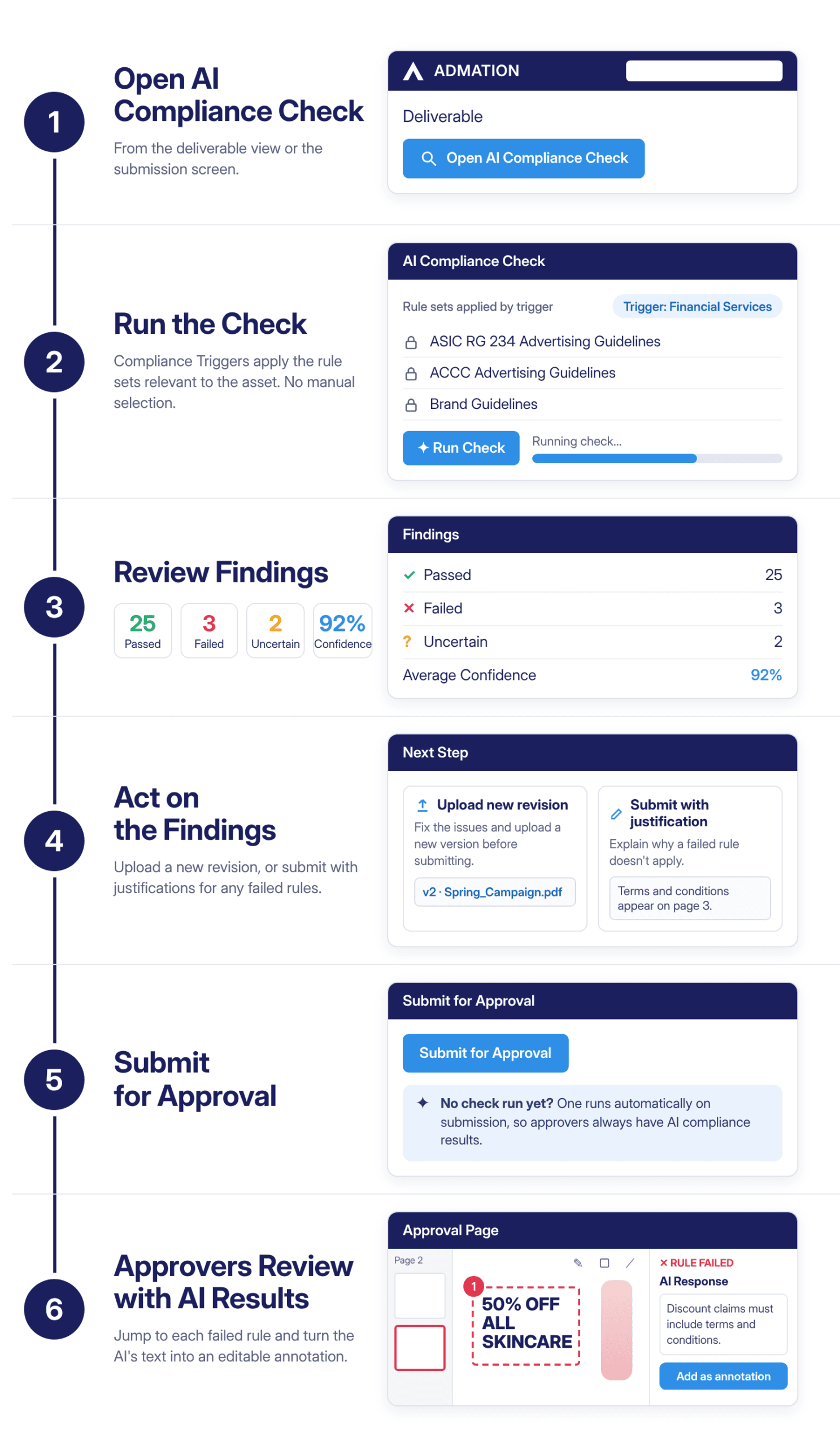
- Open the AI Compliance Check panel
From the deliverable view or the submission screen, open the AI Compliance Check panel. Running a check from the deliverable view lets you assess an asset before formal submission — at draft stage, before any approval request is raised. - Run the check
Click Run Check. Admation uses the Compliance Triggers configured for your organisation to determine which rule sets are relevant to the item — there’s no need to choose rules manually. The asset is then passed to the AI for evaluation against each rule in every relevant rule set. - Review the findings
The findings panel returns four metrics — Rules Passed, Rules Failed, Rules Uncertain, and Average Confidence % — alongside a plain-language AI summary of the overall assessment. Expand any rule set to see rule-level detail: the individual rule text and the AI’s assessment response for each rule. - Act on the findings
Based on the results, make changes and upload a new revision before submitting for approval — or submit the asset as it is, adding comments and justifications for any failed rules. - Submit for approval
Submit the asset for approval. If a check hasn’t already been run, one runs automatically on submission, so approvers always have AI compliance results to work with. - Approvers review with the AI results in view
The compliance check results are visible to approvers on the approval page (based on permissions), alongside any submitter comments. Approvers can navigate straight to the location of any failed rule and turn the AI’s failure text into their own editable annotation in one click. All proofing tools are available at this stage.
Use Cases
Brand Compliance Checking
Turn your brand guidelines into a rule set and apply it through the AI Compliance Check. The AI evaluates assets against your specific brand standards — logo usage, approved colour palettes, on-brand messaging, tone of voice, mandatory inclusions, prohibited language — alongside any regulatory rule sets that apply to the asset. Particularly valuable for organisations managing multiple agencies, brand partners or regional teams where brand consistency at scale is a persistent challenge.

Regulatory Compliance — Financial Services and Insurance
Check financial product advertisements, investment communications and promotional materials against ASIC requirements, FSC codes and internal legal standards. Create a rule set from your ASIC RG 234 compliance framework, apply pre-built ACCC and Australian Consumer Law rule sets, and add custom rule sets drawn from internal legal standards. See how Admation supports banking and financial services and insurance marketing teams. Admation is used by HESTA, Latitude Financial, NIB, Great Southern Bank, Everyday Insurance and RACV.

Regulatory Compliance — Health and Pharmaceuticals
Check health marketing content against the TGA Therapeutic Goods Advertising Code and internal medical standards — health claim permissibility, mandatory disclosures, prohibited comparative statements — before a compliance reviewer opens the file. Combine rule sets created from internal medical compliance documents with the pre-built TGA Advertising Code rule set. See how Admation supports health and pharma marketing teams. Admation is used by Bupa.

Regulatory Compliance — Retail and FMCG
Check promotional assets — catalogues, eDMs, digital banners, in-store signage — against ACCC Guidelines, Australian Consumer Law and promotional pricing rule sets. Combine rule sets created from internal pricing policy documents with pre-built regulatory rule sets. See how Admation supports retail and e-commerce teams. Admation is used by Woolworths, The Just Group, The Good Guys, Spotlight, Mitre 10, IGA, Baby Bunting and Betta.

Product and Campaign-Specific Compliance
Turn the compliance rules for a specific product, campaign or market into a rule set — promotional terms and conditions, product disclosure requirements, market-specific advertising restrictions, competition entry rules. Compliance Triggers based on campaign, market or tag then apply those rules to every asset in that campaign. This enables compliance checking that is precisely scoped to the asset and campaign context, rather than applying broad rule sets to every asset regardless of relevance.

Pre-Production Compliance Checking
Run an AI compliance check at draft stage — on scripts, storyboards, draft copy or early creative — before a job enters the formal approval process. Catching compliance issues at brief or draft stage, before design and production investment has been made, is significantly less expensive than identifying the same issue after multiple rounds of stakeholder review. AI Compliance Checking is available from the deliverable view at any stage, not just at formal submission.
Multi-Agency and Partner Network Compliance
For organisations managing content across multiple agencies, brand partners or franchise networks, AI Compliance Checking provides a consistent, documentable compliance check against the same rule sets regardless of which team produced the asset. Create rule sets from the specific brand and compliance rules that apply to each partner relationship, and triggers apply them to the right assets. Pairs with Batch Review & Approval for high-volume multi-agency campaigns.

Challenges AI Compliance Checking Solves
Compliance Checking Doesn’t Scale With Content Volume
Manual compliance checking degrades in consistency and completeness as content volumes grow. AI Compliance Checking applies selected rule sets consistently across any number of assets — without adding to reviewer workload and without the quality variation that comes from human fatigue and time pressure.
Different Rules Apply to Different Assets — and Remembering Which Is Impossible at Scale
A financial product advertisement has different compliance requirements to an internal communication. A retail promotional catalogue has different requirements to a brand campaign. A health product claim has different requirements to a general wellness communication. In Admation, Compliance Triggers ensure only the rule sets relevant to each asset are run — whether those rules come from uploaded documents, pre-built frameworks or custom rule sets — so the right rules are applied to the right work every time.
Brand Compliance Breaks Down Across Agency and Partner Networks
Organisations working with multiple agencies, regional teams or brand partners cannot reliably enforce consistent brand standards through manual checking alone as content output scales. Turning brand guidelines into a rule set and applying it in an AI compliance check creates a systematic, consistent, documented process that works regardless of who produced the asset.
No Evidence That Compliance Was Checked Before Sign-Off
Informal or email-based approval processes provide no record that compliance was assessed at the point of submission. AI Compliance Checking generates a documented result for every check run, visible to approvers on the approval page alongside all feedback, markup and comments — giving compliance and legal teams clear evidence of the compliance assessment at the point of sign-off.
Compliance Issues Are Caught Too Late
The cost of catching a compliance issue after multiple rounds of human review is significantly higher than catching it at draft or submission stage. AI Compliance Checking is available at any stage from the deliverable view, enabling compliance issues to be identified at the earliest and least expensive point in the production process.
Generic AI Checks Don’t Reflect Your Actual Compliance Obligations
AI tools that apply generic compliance rules cannot evaluate assets against the specific obligations of your organisation, regulatory environment, brand standards or product category. Because any compliance document can be turned into a rule set, AI Compliance Checking evaluates assets against the rules that actually apply — your ASIC obligations, your brand guidelines, your product-specific compliance requirements — not generic AI assumptions.