
What Is Admation? A Complete Platform Guide
Admation is a marketing approval and project workflow platform purpose-built for marketing teams, creative studios, agencies and compliance-sensitive organisations. It manages the complete creative process — from structured project briefing through task management, online proofing, multi-stakeholder approvals and compliance governance — in one connected system. Sold as Simple Admation through Simple.io, Admation is used by leading organisations including Bupa, Great Southern Bank, RACV, Woolworths, Mondelez, Spotlight Group and Tourism Australia.

Marketing teams today manage more content across more channels, with more stakeholders involved in sign-off, than at any point in the past. The tools most teams default to — email threads, shared drives, spreadsheets, general-purpose project management software — were built for generic work management, not for the specific demands of creative production and regulated approvals.
Admation was built to solve this gap. Where a general project management tool tracks tasks, Admation manages the entire creative workflow: how projects are briefed, how work moves through review stages, who approves what and in what order, and how every decision is recorded for compliance. It is one platform for the full lifecycle from brief to final asset.
This guide covers everything you need to understand about the Admation platform — how it works, what it is capable of, who it is built for, and how it fits alongside Simple’s other products.
New to Simple Admation? See the Simple Admation product page for the full feature set, pricing and a personalised demo.
Why marketing teams need a purpose-built system
The problem with general-purpose tools in marketing workflows
Marketing workflows have a specific set of requirements that general-purpose tools are not designed to meet. Three root causes drive most of the operational problems marketing teams experience, and they cannot be solved by adding more spreadsheet columns or creating another Slack or MS Teams channel.
1. Approvals involve too many stakeholders with no structured process
A campaign asset typically needs to pass through marketing, brand, legal, compliance and sometimes external agencies before it can go live. When that process runs through email, each stakeholder works in isolation — they see different versions, miss feedback from others, and there is no authoritative record of who approved what and when. In regulated industries, this is not just inefficient: it is a compliance exposure.
The result is predictable: approval cycles stretch, versions multiply, deadlines slip, and teams are not confident that what they are publishing has actually been signed off correctly. For more on how this breaks down, see why marketing approvals break down and how to fix the process.
2. Creative projects are not task lists
General project management tools model work as tasks with owners and due dates. Creative projects have a different structure — a deliverable goes through briefing, briefing approval, creative development, internal review, revisions, stakeholder review, further revisions, final approval, and archiving. Each stage has dependencies, permissions and version control requirements that task lists cannot capture.
Without a system that understands this structure, teams build workarounds: complex spreadsheets to track artwork revisions, separate tools for proofing, email for feedback consolidation. Each workaround adds overhead and creates gaps where things fall through.
3. Compliance requires documentation that email cannot provide
For teams in financial services, insurance, health and retail, marketing content must meet regulatory standards. That means documented evidence that the right people reviewed the right version of the right asset at the right stage — and that any changes made after a review were re-approved. Email cannot reliably provide this audit trail, and general project management tools were not built to capture it.
The consequence of inadequate compliance documentation is not just an internal efficiency problem — it is a legal and brand risk. See how marketing compliance best practices work in practice for regulated teams.
Admation was built specifically to address these three root causes — not as a general workflow improvement, but as a purpose-designed system for how marketing and creative teams actually work.
How Admation works: the four modules
One platform, four connected modules
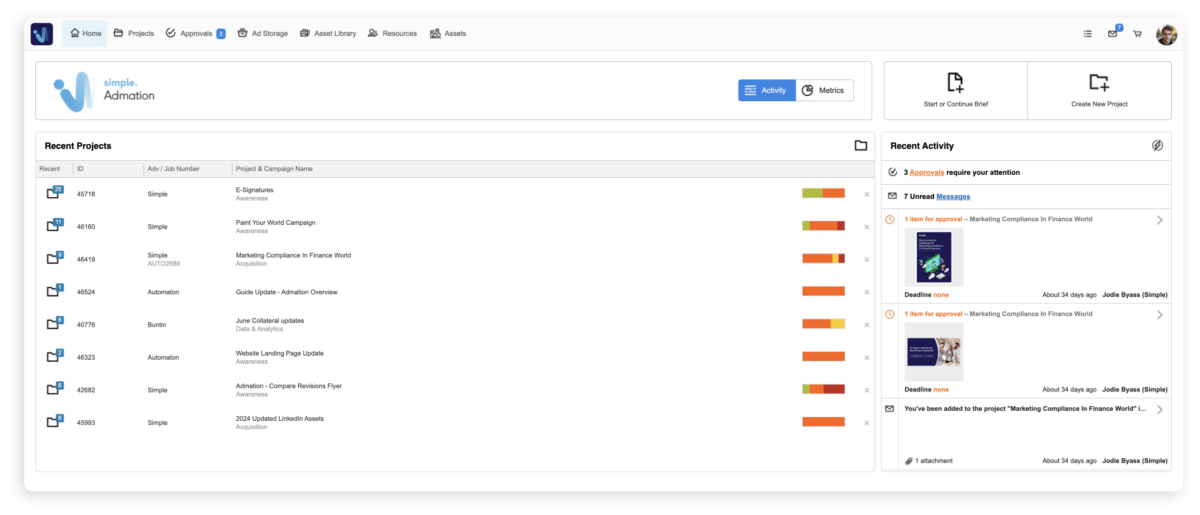
Admation is structured around four modules that correspond to the four stages of a creative project’s lifecycle. The key distinction from a suite of separate tools is that these modules are connected — a project brief created in Module 1 flows directly into the workflow in Module 2, which feeds into approvals in Module 3, with final assets stored in Module 4. Data does not move between tools; it moves within the same system.
Module 1 — Marketing Project Management
Project management in Admation starts with briefing — structured online brief templates that capture every required detail before creative work begins. Mandatory fields prevent incomplete briefs from being submitted. Once approved, the brief becomes the project foundation: task scheduling, resource assignment, deadline setting and campaign calendar all flow from it.
This module owns project visibility. Teams see the status of every project in real time, managers see resource allocation and workload across the team, and nothing falls through because it is tracked from the first moment of the brief. → Marketing project management solution.
Module 2 — Marketing Resource Management
Resource management in Admation is integrated with the project system — which means resource allocation decisions are made in context of actual workloads, not guesswork. Managers see each team member’s capacity before assigning tasks, automated scheduling optimises allocation across concurrent projects, and time tracking gives accurate data for future planning.
The practical benefit is that projects do not stall because the right person is unavailable and no one knew it. → Marketing resource management solution.
Module 3 — Approval Workflow
Approval workflow is Admation’s centrepiece capability. Instead of routing artwork through email for feedback, all review and approval and online proofing happens within the platform. Reviewers receive notifications, mark up assets using a full annotation toolkit, and submit structured feedback in one consolidated view. Multi-level approval pathways ensure the right stakeholders sign off in the right sequence — and automated reminders mean nothing sits waiting without follow-up.
For compliance-sensitive teams, every approval decision is automatically recorded in a tamper-proof audit trail with timestamps, version references and reviewer identities. → Approval workflow software and online proofing solutions.
Module 4 — Digital Asset Management
Once a campaign asset is approved, it moves directly into Admation’s integrated digital asset management library — a centralised, permission-controlled repository where approved assets are stored, organised and made available for distribution. Teams access the current approved version without hunting through drives or inboxes. Version history and audit trail carry through from the approval stage.
This module closes the loop: brief → produce → approve → store is one connected process, not four separate systems. → Simple Asset Manager for the standalone DAM product.
How the modules connect: A marketing manager creates a project brief in Module 1. Tasks are assigned from the brief and workloads checked in Module 2. Creative assets are submitted for review through Module 3, where all feedback is consolidated and approvals recorded. Approved assets are published to Module 4, where they are available to the team with full audit trail intact. The campaign lifecycle completes in one system.

Admation's six capability groups
A deeper look at what Admation can do
The four modules above describe how Admation is structured. Admation’s capabilities are organised into six groups that reflect the specific workflow challenges they address. Each group maps to a distinct operational problem — and a corresponding solution page where you can explore the capability in full detail.
1. Project Briefing & Setup
Admation’s briefing tools ensure every creative project starts with complete, accurate information. Customisable online brief templates capture mandatory fields, define deliverables, set deadlines and assign tasks before any creative work begins. Briefs can be routed through a fast approval process before work starts — so the brief itself is signed off, not just assumed.
Why it matters: Weak briefs are the single most common cause of high revision counts. A project that starts with an incomplete brief will generate clarification requests, scope changes and version cycles throughout its lifecycle. Structured briefing eliminates this at the source.
Creative briefing software — brief templates, mandatory fields and brief approvals
2. Approval Workflow & Review
Admation replaces email-based approval processes with a structured, multi-level workflow. Approval pathways define who must review at each stage and in what sequence. Reviewers annotate assets directly — drawing, highlighting and commenting with a full markup toolkit. Side-by-side version comparison makes it clear what changed between revisions. Batch approval handles high-volume campaigns efficiently.
Why it matters: Email approval processes produce conflicting feedback, lost sign-offs and no reliable audit trail. Structured workflows eliminate each of these problems — and for regulated industries, the automated audit trail turns compliance documentation from a manual task into an automatic output.
Marketing approval workflow — multi-level approvals, checklists and audit trails
3. Online Proofing & Feedback
Admation’s online proofing tools allow all reviewers to mark up, annotate and comment on artwork, video, HTML files and Microsoft Word documents directly within the platform. All feedback from multiple reviewers is consolidated into a single view before it reaches the creative team — no conflicting instructions, no email threads to reconcile. Every comment, markup and change request is timestamped and version-linked.
Why it matters: Creative teams waste significant time reconciling contradictory feedback from multiple reviewers. Consolidated, structured feedback reduces revision counts and gives creative teams clarity on exactly what changes are required and in what priority.
Online proofing tools — markup, annotation and side-by-side version comparison
4. Marketing Compliance & Governance
Admation’s compliance capabilities include customisable approval checklists (reviewers must complete specific checks before sign-off is possible), role-based access controls, version locking (preventing distribution of unapproved content), and a tamper-proof automated audit trail that records every action, approval decision and change. Risk calculators and compliance checklists guide reviewers through required steps.
Why it matters: In regulated industries, non-compliant marketing content carries legal, financial and reputational consequences. Admation embeds compliance into the workflow rather than treating it as a downstream check — which means compliance is verified during production, not discovered after a campaign has gone live.
Marketing compliance — approval checklists, audit trails and governance tools
5. Resource Planning & Management
Admation’s resource management capability gives managers real-time visibility of team capacity before allocating work. Automated scheduling optimises workloads across concurrent projects. Tasks can be reassigned quickly when priorities shift. Time tracking and timesheets provide accurate data for future resource and budget planning. The away day board prevents tasks from being assigned to unavailable team members.
Why it matters: Overloaded creative teams miss deadlines, produce lower-quality work and burn out. Resource bottlenecks are one of the most common causes of approval delays — if the right reviewer is not available at the right stage, the approval cycle stalls regardless of how efficient the approval workflow is.
Marketing resource management — capacity planning, task allocation and scheduling
6. Reporting & Workflow Insights
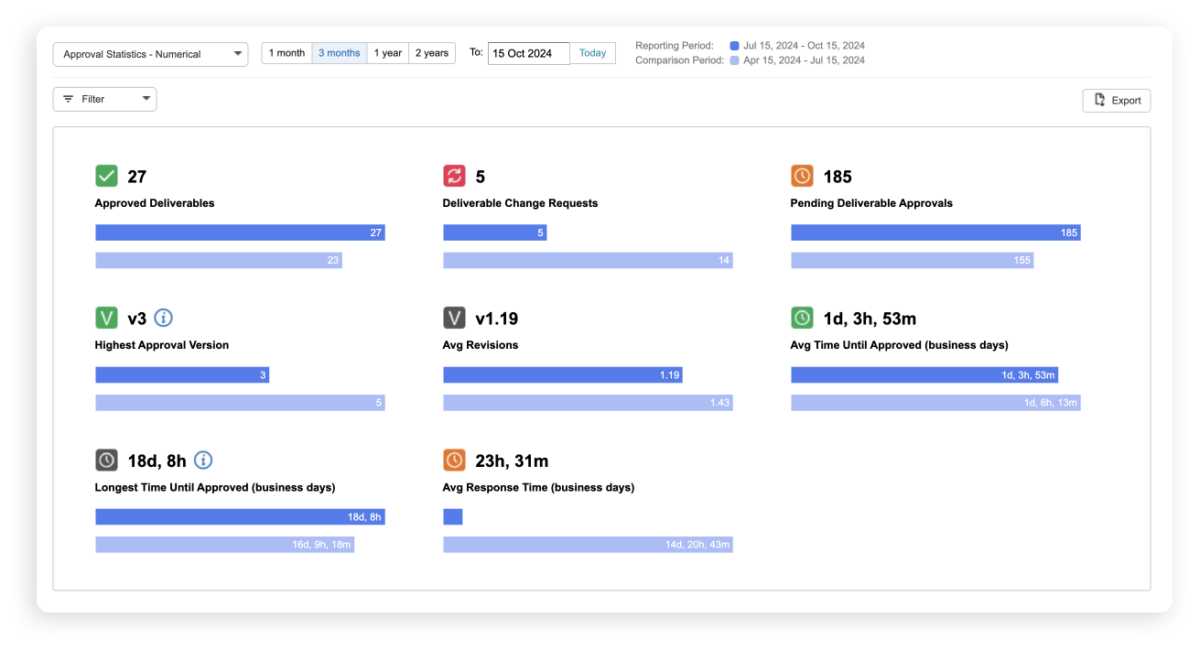
Admation provides real-time dashboards, WIP (Work in Progress) reports, artwork revision count reports, resource utilisation reports and Gantt charts. Managers see project status, approval bottlenecks, resource utilisation and compliance data in one view. Reporting is live — not a manual export from a spreadsheet.
Why it matters: Without reporting, workflow problems are invisible until they have already caused damage. Revision count reports reveal where briefs are consistently weak. Resource utilisation reports surface overloaded team members before burnout occurs. Compliance reporting provides the documentation trail needed for regulatory reviews.
Marketing project management — reporting, dashboards and WIP visibility

See Simple Admation in Action.
If the capabilities above map to challenges your team is experiencing, the fastest way to understand how Admation would work for your operation is to see it in a live context.
Book a DemoWho Admation is built for
The teams and industries that rely on Admation
Admation is used across different team types and industries — but the common thread is organisations where marketing content must meet a high standard of review before it reaches the market. Below is a breakdown of the specific teams that rely on Admation, the challenges they face, and the outcomes they get.
Marketing managers and campaign teams
Challenge: Managing multiple campaigns simultaneously with clear visibility of what is at each stage, who is working on what, and where approvals are stuck — without spending hours chasing status updates.
How Admation helps: Admation provides a real-time project dashboard showing every active campaign, its status, its deadline and its current approval stage. Automated reminders replace manual follow-up. Brief templates ensure every project starts with the right information.
Outcome: Marketing managers gain full visibility across all active projects without the administrative overhead of status meetings and spreadsheet updates. Campaign delivery becomes more predictable, and approval delays become visible before they become missed deadlines.
Traffic managers and creative studio teams
Challenge: Assigning work to the right resource at the right time — without overloading team members — while keeping projects moving through review stages with clear, actionable feedback.
How Admation helps: Admation’s resource management tools show each team member’s current workload before any task is assigned. Creative teams receive consolidated, structured feedback from all reviewers in one view — not conflicting emails from multiple stakeholders. Version control ensures they are always working on the latest approved file.
Outcome: Traffic managers reduce last-minute reshuffling and overloading. Creative teams spend less time tracking down feedback and more time producing quality work. Revision counts fall because briefs are clearer and feedback is structured from the start.
Compliance and legal teams
Challenge: Ensuring every piece of marketing content passes through the appropriate legal and compliance review — at the right stage, with the right version — and that evidence of that review is available for regulatory purposes.
How Admation helps: Admation’s multi-level approval pathways can be configured to include mandatory compliance and legal review at specific stages. Approval checklists ensure reviewers complete required checks before sign-off is possible. The automated audit trail records every approval decision with timestamps and version references. For a structured approach to compliance workflow, see marketing compliance best practices.
Outcome: Compliance leaders can demonstrate that every piece of marketing content was reviewed by the right people, at the right stage, with the correct version — without manual documentation. Regulatory reviews and audits become a matter of retrieving the record, not reconstructing it.
CMOs and marketing operations leaders
Challenge: Visibility across the entire marketing operation — resource utilisation, approval performance, campaign delivery rates, and compliance posture — without relying on manual reporting from the team.
How Admation helps: Admation’s reporting dashboards surface real-time data on project status, resource utilisation, revision counts and approval cycle times. Leaders see where the operation is performing well and where bottlenecks are forming — before they escalate. The platform gives marketing operations the kind of visibility that was previously only available in post-project retrospectives.
Outcome: CMOs make resource and process decisions based on live data rather than estimates. Marketing operations becomes measurable — revision counts, approval cycle times and resource utilisation are tracked over time, making it possible to identify systemic improvements rather than just firefighting individual projects.
Ad agencies and creative agencies
Challenge: Managing client review and approval cycles — where feedback comes from multiple client stakeholders with different seniority and different expectations — while maintaining visibility of all active projects and protecting the agency’s own compliance position.
How Admation helps: Admation allows agencies to manage client access with role-based permissions — clients participate in the approval workflow through a controlled interface without seeing the full internal project management system. All client feedback is consolidated before it reaches the creative team. Batch approval handles high-volume campaigns. The full audit trail protects the agency in any post-project dispute.
Outcome: Agencies deliver faster client approvals with less administrative overhead. Client feedback is clearer, revision counts are lower, and every decision is documented. The audit trail provides protection in disputes over whether changes were requested or approved.
Industries: Admation is used across financial services, insurance, banking, health and pharmaceuticals, retail and consumer goods, government, and media. It is most widely adopted in regulated industries where compliance documentation is non-negotiable — see the banking and financial services use case and the health and pharma use case for specific applications.
How Admation fits the Simple suite
Admation within the Simple marketing operations platform
Admation is sold as part of Simple.io — a suite of marketing operations software that includes four products. Understanding how Admation relates to the other products helps clarify when Admation is sufficient on its own, and when adding other products extends its value.
Admation standalone
Admation operates as a complete end-to-end marketing workflow platform on its own. Teams using Admation without other Simple products get full project management, resource management, approval workflow and basic asset storage in one platform. For most marketing teams, this covers the complete workflow. SSO is supported for enterprise access management.
Admation + Simple Asset Manager
The most common combination. Simple Asset Manager is a dedicated digital asset management platform with AI-powered search, advanced metadata, bulk operations and distribution capabilities that go beyond Admation’s built-in DAM module. When campaign assets are approved in Admation, they can be published directly into Asset Manager’s library — creating a continuous chain from brief to production to approved asset library.
This combination is typically chosen by teams managing large volumes of assets across multiple campaigns, or organisations with complex asset distribution requirements across markets, agencies and partners.
Admation + Simple Brand Manager
Simple Brand Manager is a brand identity hub — it stores and governs brand guidelines, logos, colours, typography and approved brand elements. Where Admation manages campaign workflow, Brand Manager ensures the inputs to that workflow (brand assets, approved templates, identity elements) are always current and correctly applied.
This combination is typically chosen by organisations with complex brand governance requirements — multiple brands, regional variants, agency partnerships — where brand consistency needs active management rather than relying on team knowledge.
Admation + Simple Retailpath
Simple Retailpath is a product information management and retail promotion platform. It is most relevant to retail organisations managing large volumes of product-specific marketing content. Admation handles the approval workflow for that content; Retailpath manages the product data and promotional structure that feeds into it.
In summary: Admation is the workflow and approval engine of the Simple suite. The other products extend specific capability areas — richer asset management (Asset Manager), brand governance (Brand Manager), retail product data (Retailpath) — without duplicating the core workflow. Each can be added independently based on where your organisation’s operational needs are greatest.

Admation by the numbers
400+
Organisations

14,000+
Enabled Users

308,000+
Assets Stored

1,035,000+
Artwork Revisions

158,000+
Projects Managed

Admation customers include Bupa, Great Southern Bank, RACV, Woolworths, Tourism Australia, The Good Guys, Spotlight Group and Bank Australia. Customers span financial services, insurance, health, retail and media — predominantly in Australia, with growing enterprise adoption globally.
Is Admation the right fit for your team?
When Admation delivers the most value
Admation is purpose-built for a specific operational context. Understanding whether that context matches your team’s situation is the most useful question to answer before evaluating the platform.
Admation is likely the right fit if your team:
- Manages marketing content that requires multi-stakeholder review and sign-off before publication.
- Operates in a regulated industry where compliance documentation of approvals is required or expected.
- Is experiencing high revision counts, missed deadlines or approval bottlenecks that trace back to process problems rather than people problems.
- Is using email, shared drives or spreadsheets to manage approvals and has outgrown those tools.
- Needs a full audit trail — who approved what version, when, and what changes were made after each review.
- Is an agency managing client approvals across multiple concurrent projects.
Where Admation differs from general project management tools
Tools like Asana, Monday.com and Jira are built for task and project tracking across any type of work. They are excellent at what they do — but they do not manage creative approval workflows. They have no concept of multi-level approval pathways, online proofing with markup tools, approval checklists, or automated compliance audit trails.
When marketing teams use general project management tools for approval processes, they typically end up routing feedback through comments, attaching files to tasks, and manually tracking who has and has not signed off — all of which recreates the core problems of email-based approvals with additional tool overhead. See why Jira is not built for marketing teams for a detailed breakdown of where the gaps occur.
When Admation may not be necessary
If your team manages a small number of simple campaigns with a single approver and no compliance requirements, Admation’s structured workflow may be more overhead than your operation needs. The platform delivers the most value as project volume, stakeholder count and compliance requirements increase — typically from mid-sized marketing teams upwards.
The fastest way to assess fit is to map your current approval process against Admation’s workflow model. If your team regularly experiences missed sign-offs, conflicting feedback, version confusion or compliance uncertainty, those are the operational problems Admation is specifically designed to solve.
Ready to see how Admation fits your workflow?
The Admation product page covers the full feature set with detailed capability sections. Or if you are ready to see it in your context, book a personalised demo.
Book a DemoFrequently Asked Questions
What is Admation used for?
Admation is used to manage the marketing and creative approval process — the part of campaign production where work gets delayed, versions get lost and sign-offs fall through the gaps. It covers structured project briefing, task management, online proofing, multi-stakeholder approval workflow and compliance reporting, and is most commonly used by marketing teams, in-house creative studios, traffic managers and compliance teams that need a documented audit trail for every approval decision.
Is Admation only for large enterprise teams?
No. Admation is used by organisations of all sizes — from growing in-house teams and boutique agencies to large enterprise marketing operations. The structured approach makes it valuable for any team that needs to manage multi-stakeholder approvals with compliance documentation, regardless of headcount. See the Simple Admation product page for plan and pricing details.
How is Admation different from Asana, Monday.com or Jira?
General project management tools track tasks across any type of work. Admation is purpose-built for marketing and creative workflows — specifically for the review and approval process. It provides multi-level approval pathways, online proofing with markup tools, approval checklists, version locking and an automated compliance audit trail. These capabilities do not exist in Asana, Monday.com or Jira. For a detailed comparison, see why Jira is not built for marketing teams.
Does Admation manage the full creative process from brief to final asset?
Yes. Admation covers the complete campaign lifecycle in three connected stages: planning and creative briefing (project setup, task assignment, resource scheduling and brief approval); creative production and review (stakeholder reviews, online proofing with markup tools, version control and collated feedback); and sign-off and governance (multi-level approvals, compliance checklists, final asset storage and audit reporting). Teams can run all three stages in one platform without switching tools between them.
Which industries use Admation?
Admation is used across financial services and insurance, banking, health and pharmaceuticals, and retail. It has the deepest adoption in regulated industries — financial services and insurance in particular — where marketing content must pass through documented approval processes and audit trails are required for regulatory compliance. Australian customers include Bupa, Bank Australia, RACV, Woolworths and Tourism Australia.
How does Admation connect with Simple Asset Manager and Brand Manager?
Admation integrates directly with Simple Asset Manager — when campaign assets are approved in Admation, they can be automatically published to the Asset Manager library, ensuring only final approved materials are stored and distributed. Simple Brand Manager provides the brand identity hub — logo storage, colour and typography guidelines, brand governance — that feeds into Admation’s workflow as the source of approved brand materials. Simple Asset Manager and Simple Brand Manager can each be licensed as part of the Simple suite alongside Admation, or evaluated separately depending on your team’s requirements.