
How to Consolidate Your Marketing Project Management Software
Jodie Byass
Published: 19 August 2026
Share


Consolidating the tools you use to manage marketing work makes sense when they handle stages of the same process, and less sense when they support genuinely different ones. Briefing, project management, proofing, approvals and approved asset storage belong together, because the handoffs between them are where work goes missing. CRM, marketing automation and analytics serve different processes — they may integrate well, but they do not belong in the same consolidation exercise simply because they sit in the marketing budget.
This article is about the marketing project and creative workflow layer specifically, not a full martech audit. It is the group of tools where fragmentation costs the most and where consolidation is most often worth doing.
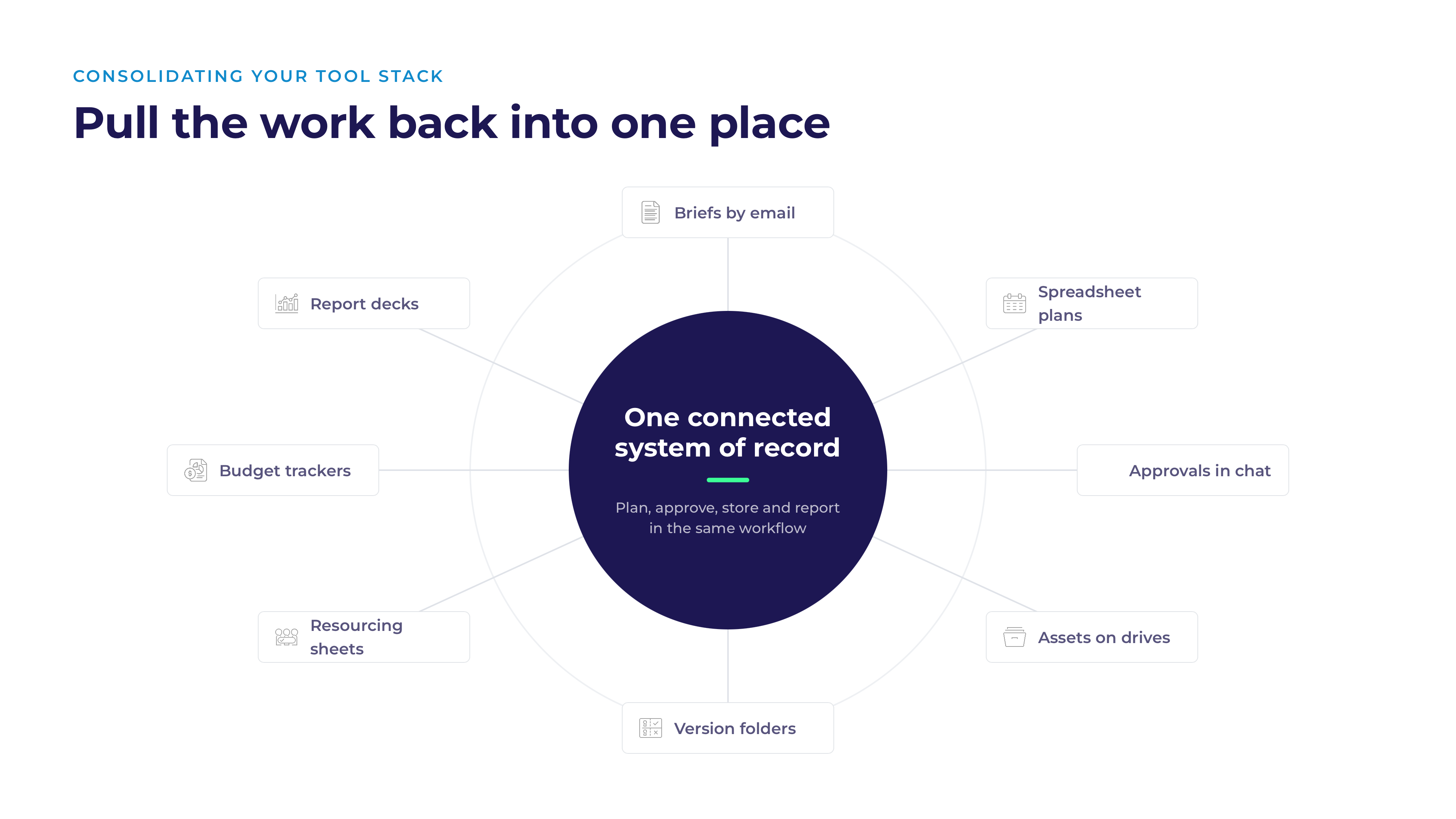
The exercise usually starts the same way. Someone notices the annual spend, or a renewal lands, or a new marketing lead arrives and asks why there are eleven subscriptions.
The instinct is to count tools and cut the number. That is the wrong measure. Fifteen tools that each do one thing well is a healthier position than six that each do four things adequately.
The better question is where the seams are — the points where work moves from one system to another, because that is where things break.
Why the seams matter more than the count
When tools are not properly connected, every handoff creates another manual step — and manual steps are where marketing work goes wrong.
A brief written in a document has to be sent to whoever is doing the work. The artwork produced has to be uploaded somewhere for review. Feedback collected in one place has to be relayed to the person making changes. Approval given in email has to be recorded somewhere it can be found later. The approved file has to be moved to wherever approved files live.
Each of those is small. Together they are somebody's week, and every one is a point where a version can go astray or a decision can be lost.
Counting tools does not surface any of this. Mapping the handoffs does.
Which marketing project tools can be consolidated?
These are stages of one process, not separate disciplines. They are usually run as separate tools because they were bought separately.
- Briefing and request intake — how work arrives and gets scoped
- Project and resource management — what is in progress, who is doing it, who has capacity
- Online proofing — mark-up and feedback on the actual asset
- Approval routing — who signs off, in what order, with what recorded
- Approved asset storage — where the final file lives and who can use it
The case for merging these is not that fewer logins is nicer. It is that the brief, the work, the feedback, the decision and the final file are all the same object at different stages. When they live in five systems, nothing connects them except a person, and that person becomes the integration.
Worth being precise about what that requires. These capabilities need to be connected — they do not always need to sit in a single application. What matters is that the approved asset stays linked to its project, its feedback, its versions and its approval history.
The test: can you take an asset that went to market last quarter and, in one place, see the brief it came from, every version, who commented, who approved, and which file was released? If that takes three systems and a conversation, the seams are costing you more than the licences.
Which platforms should stay separate?
Some tools look adjacent and are not. Merging them usually means buying a compromised version of both.
- CRM — different owner, different data model, usually shared with sales
- Marketing automation and email — a delivery and nurture discipline, not a production one
- Analytics and attribution — specialist, and you want the best available rather than a bundled approximation
- Media buying and ad platforms — genuinely separate, with their own operators
- Design and production tools — creative teams should use what they are best in; the workflow platform manages the process, not the making
The broader a platform's scope, the more carefully you need to assess the depth of each capability. A long feature list does not mean every function will support the way your team actually works, and any capability that falls short may eventually require another tool — which undermines the reason you consolidated in the first place.
Consolidate or integrate?
These are different decisions and they get conflated.
Consolidation means replacing two or more tools with one platform. It suits tools managing consecutive stages of the same work, where the same projects, people and assets already exist in both and someone is manually keeping them aligned.
Integration means keeping specialist platforms and letting information move between them. It suits tools serving different purposes that need to exchange data — your CRM and your project platform, for instance, or your asset library and your website.
The mistake is treating consolidation as always better. A team that consolidates two genuinely different disciplines into one adequate platform has not simplified anything; it has traded two good tools for one compromised one. A team that integrates tools which duplicate each other has automated the duplication rather than removing it.
Briefing, proofing and approvals are usually strong candidates for consolidation. CRM and marketing project management are more likely to stay separate and integrate where they need to exchange information. Getting that the wrong way round is the expensive version of this exercise.
How to audit your marketing project tools
Before deciding anything, three questions are worth answering properly.
Record the same fields for every tool involved in getting work from brief to approved asset. For a small stack this is an afternoon's work. For a larger organisation, assign an owner and complete the inventory before any renewal decisions come up.
| Record | Why it matters |
|---|---|
| Primary purpose | What the platform was bought to do |
| Teams using it | Whether use is broad or isolated |
| Active users | Actual adoption compared with licence count |
| Annual cost | The direct subscription cost |
| Renewal date | When you can act without an early termination cost |
| What it manages | Projects, assets, approvals, files |
| Integrations in place | What could be affected if it is removed |
| Information entered manually | Where duplication occurs |
| Capabilities duplicated elsewhere | Where genuine overlap may exist |
| Records that must be retained | Approval history, audit evidence |
| Consequence if removed | What would no longer work |
Three of those fields do most of the work.
What is each tool genuinely used for?
Not what it was bought for — what people do with it now. Teams routinely discover a platform bought for four capabilities is being used for one, and that one is available in something else they already own.
Combine usage data with conversations rather than relying on either alone. Login frequency and active-user counts show whether a platform is being adopted. Talking to the people using it reveals why it is or is not, and whether a small number of users depend on it for something critical that nobody else has noticed.
Where does work stop and wait?
Map a recent campaign end to end and mark every point where something moved between systems, or where someone had to chase, copy or re-enter information.
Those points are your real cost. They rarely appear on any invoice.
What would actually break if this went away?
For each tool, name what stops working. If the answer is vague, you have a candidate. If the answer is "the compliance team's audit record", you do not.
How to tell real overlap from apparent overlap
Two tools can appear to do the same thing and be doing quite different jobs.
A project management platform and a marketing workflow platform both track tasks. But one models work as tasks with owners and dates, and the other models a single asset moving through review stages with a governed decision at the end. Replacing the second with the first loses the approval record, which you may not notice until someone asks for it.
Equally, a shared drive and a digital asset library both store files. One holds everything anyone ever put there; the other holds what is currently approved, with permissions, versions and expiry. Those are not the same product.
Before cutting anything, ask what the tool does that the survivor does not. If the honest answer is nothing, cut it. If the answer is "it keeps the record", think again.
Check what happens to your external partners
Consolidation exercises usually assess internal use and forget that agencies, freelancers and production partners are also in these systems.
Whatever you consolidate into needs to let external partners reach the projects and assets relevant to them while your team keeps control of permissions, keep their feedback attached to the asset rather than in a separate thread, route their deliverables through the same approval process as internal work, ensure everyone is working from the current version, and leave the project and approval records with you when the engagement ends.
If a candidate platform charges per external reviewer, factor that in early — it tends to determine who ends up inside the process and who gets emailed a PDF. There is more on this in our guide to managing a hybrid in-house and external agency team.
When is consolidation worth it?
You do not need a full audit to recognise the pattern. Consolidation is generally worth considering when several of these are true:
- The same project information is entered into more than one system
- Feedback and approvals routinely happen over email
- Nobody can say with confidence which version of an asset is current
- Your project, proofing and approval tools contain the same users and the same assets
- Reporting requires someone to combine information manually
- External agencies work outside the controlled workflow
- Approval records are difficult to retrieve when asked for
- The combined cost of duplicated tools is approaching the cost of a more complete platform
One or two of these is normal. Five or more usually means the fragmentation is costing more than the licences.
What it actually costs to change platforms
Consolidation business cases usually compare licence fees. The licence is the small number.
The real costs are configuring the new platform to match how you work, migrating what needs to come across, retraining people who were productive in the old thing, and the productivity dip while a team learns a new process under normal deadline pressure.
None of that argues against consolidating. It argues for consolidating deliberately — fewer, larger moves rather than continuous small ones, and a genuine reason each time.
It is also why the adoption question matters as much as the selection question. A consolidated stack that nobody uses properly is worse than the fragmented one it replaced, because now there is no fallback. We have written separately about why martech tools go underused and how to improve adoption.
Where Simple Admation sits
Simple Admation connects the stages of marketing work that most often end up fragmented across separate platforms: briefing, project management, resource and capacity, online proofing, version control, approval routing and reporting. An audit trail records the activity, feedback and decisions across the whole project. Simple Asset Manager provides a connected home for the approved assets that come out of it.
It does not replace your CRM, your automation platform or your analytics, and it is not meant to. Its role is narrower: helping internal teams and external partners manage creative projects from brief to approval while keeping visibility, accountability and compliance records intact. The creative workflow is one connected process, and running it across five systems creates costs and risks that the five subscription fees do not show.
For teams comparing options, our guide to the best marketing project management softwarecovers the category.
Frequently asked questions
Which marketing tools should you consolidate?
Consolidate tools that handle stages of the same process rather than tools that happen to sit in the same budget. Briefing, project management, proofing, approval routing and approved asset storage are the clearest candidates, because the brief, the work, the feedback, the decision and the final file are the same object at different stages. When those live in separate systems, nothing connects them except a person manually moving information between them. Tools serving different disciplines — CRM, marketing automation, analytics, media buying — may integrate well with your workflow, but they do not belong in the same consolidation exercise.
How do you decide which marketing tools to cut?
Start by establishing what each tool is genuinely used for now, rather than what it was bought for, using login and activity data rather than asking people. Then map a recent campaign end to end and mark every point where work moved between systems or someone had to chase, copy or re-enter information. Finally, for each tool, name specifically what would stop working if it went away. A vague answer indicates a candidate for removal. An answer like "the compliance team's approval record" does not.
Is an all-in-one marketing platform a good idea?
It depends whether the capabilities being bundled belong to one discipline or several. A platform covering briefing, project management, proofing and approvals is combining stages of a single process, which generally works well. Where a platform spans several distinct disciplines, assess the depth of each capability rather than the length of the feature list — a function that does not support how your team works is one you will replace, which leaves you running a partial migration on a platform chosen for something else.
Can one platform replace separate project management, proofing and approval software?
Often, yes — these manage consecutive stages of the same work and usually contain the same projects, people, deadlines and assets, so keeping them separate means someone maintains the alignment manually. A specialist marketing workflow platform typically combines briefing, task and resource management, proofing, version control and approval routing. Before replacing anything, confirm the new platform preserves what the existing tools do that matters: the approval record, the permission model, and the workflow controls your compliance obligations depend on.
What is the difference between consolidating and integrating marketing tools?
Consolidation replaces two or more tools with one platform. Integration keeps specialist platforms and lets information move between them. Consolidation suits tools handling consecutive stages of the same work, where the same projects and assets exist in both and someone is manually keeping them aligned. Integration suits platforms serving genuinely different purposes that need to exchange data — a CRM and a marketing project platform, for example. Treating consolidation as always better is how teams end up trading two good tools for one adequate one.
How do you audit your marketing project management software?
List every platform used between the initial brief and final asset approval. For each one, record its purpose, users, active user count, annual cost, renewal date, integrations, capabilities duplicated elsewhere, and any records that must be retained. Combine usage data with conversations, since login figures show whether a tool is adopted but not why, or whether a small group depends on it for something critical. Then map a recent project and mark every point where information, files or decisions moved manually between systems — that reveals both unnecessary software and workflow gaps that subscription costs alone will not show.
What does it actually cost to consolidate marketing tools?
The licence difference is usually the smallest number in the calculation. The larger costs are configuring the new platform to match how the team works, migrating whatever needs to come across, retraining people who were already productive in the previous system, and the productivity dip while everyone learns a new process under normal deadline pressure. This does not argue against consolidating, but it argues for doing it deliberately — fewer and larger moves with a clear reason each time, rather than continuous small changes.