
What Is a Creative Brief? The Complete Guide to Brief Management
A creative brief is the document that defines what a creative project needs to achieve before any work begins. It captures the objectives, audience, deliverables, deadlines, budget, and compliance requirements that a creative team, client, and approval stakeholders all agree to upfront — and that the work is measured against throughout.
When a brief is complete and approved before production starts, teams work from the same source of truth. When it isn’t, the gaps surface in the middle of production — as revision requests, compliance flags, and scope disputes that could have been resolved in the brief at a fraction of the cost.
This guide covers what a creative brief is, what makes brief management work in practice, why most briefs break down, and how structured brief management software changes the equation for teams at scale.
If you’re evaluating software to manage, approve, and track briefs — see Admation’s creative briefing software. This guide focuses on what a creative brief is and how brief management works.
How to Write a Creative Brief: The Complete Guide.
What Is a Creative Brief?
A creative brief is the foundational alignment document for a creative project. It answers the questions every team member needs answered before work begins:
- What are we making? The deliverables — specific formats, sizes, quantities, platforms.
- Why are we making it? The objectives — what the work needs to achieve, measured against what.
- Who is it for? The audience — demographic, psychographic, and behavioural detail.
- What must it say? The key messages, mandatory inclusions, regulatory language.
- When does it need to be done? Deadlines, milestones, dependencies.
- What are the constraints? Budget, resources, compliance requirements, brand parameters.
- Who needs to approve it? The stakeholders, their roles, and the sign-off sequence.
A brief is not a project plan. A project plan defines how work gets delivered — tasks, timelines, resources. A brief defines what gets delivered and why it matters. Both are necessary; neither substitutes for the other.
A brief is also not a scope document or a requirements spec. It’s a creative alignment tool — it gives a creative team the context, direction, and constraints they need to produce work that meets the objectives without requiring constant clarification.

What Does a Creative Brief Include?
The specific fields in a creative brief vary by organisation and project type, but a complete brief covers seven areas consistently. These are the sections where gaps cause the most expensive problems.
Project Purpose and Objectives
What is this project trying to achieve, and how will you know if it worked? Objectives should be specific and measurable where possible. ‘Raise brand awareness’ is not an objective. ‘Drive a 15% increase in unaided brand recall in the 25–34 demographic through Q3 activity’ is. The clearer the objective, the easier it is to evaluate whether the creative work delivers it — and the harder it is for scope to drift.
Target Audience
Who is the work for? Audience definition should go beyond basic demographics to include psychographic and behavioural context. Knowing whether you’re targeting existing customers, lapsed buyers, or new prospects changes the message, tone, and channel significantly. Include any relevant audience insights, customer data, or research the creative team should know.
Key Messages and Mandatory Content
What must the work communicate? What is the single most important message? What mandatory content — brand statements, disclaimers, regulatory language, legal copy — must be included regardless of creative direction? This is the section where most briefs are weakest. Teams assume mandatory content is common knowledge. It isn’t. And when a compliance requirement surfaces in the final review because it wasn’t in the brief, the cost is significant.
Deliverables and Format Specifications
What exactly needs to be produced? Every deliverable should be specified: format, dimensions, resolution, file type, platform, quantity. ‘A social campaign’ is not a deliverable. ‘3 x static posts for Instagram (1080 x 1080 px, RGB, max 2MB each) + 1 x story (1080 x 1920 px)’ is a deliverable. Vague deliverables produce vague work — and create disputes at review about whether the work matches what was asked for.
Deadlines and Key Milestones
When is each deliverable due? When are the approval checkpoints? When does work go live? Milestones should be specific dates, not ‘end of month’. Dependencies should be noted — if the video brief depends on a photography shoot, the brief should say so. Stakeholders who sign off on a brief with concrete dates are accountable to those dates in a way that a vague timeline doesn’t create.
Budget and Resource Requirements
What budget is allocated? Who is assigned to the project — project manager, designer, copywriter, external agency? Resource constraints defined in the brief prevent scope creep and over-servicing. They also mean the brief approval process includes a sign-off on what the project will cost, not just what it will produce.
Compliance and Regulatory Requirements
For regulated industries — financial services, insurance, pharmaceutical, retail — this section is non-negotiable. Which regulatory frameworks apply? What disclosures are mandatory? What approval sequence is required before work can go live? Compliance requirements attached to the brief at project initiation can’t be missed in production. Compliance requirements living in a separate document or email chain frequently are.
In Admation, brief templates are built with mandatory fields for each of these sections — a brief can’t be submitted until every required field is complete. See how brief templates work
Why Creative Brief Management Matters
Having a brief template is not the same as having brief management. Brief management is the system — the process, tools, and governance — that ensures briefs are complete, approved, and connected to the work they initiate throughout the project lifecycle.
The difference matters because most brief problems don’t come from teams not knowing what a brief should contain. They come from the way briefs are created, reviewed, stored, and used in practice.
Briefs in documents create version control problems
When a brief lives in a Word document or shared folder, it gets updated by one person and not seen by others. Different team members reference different versions. The brief that the creative team worked from and the brief that the client approved at kick-off diverge without anyone noticing until there’s a dispute.
Briefs in email create no approval record
‘We agreed to this in the brief’ is only meaningful if there’s a record of who agreed to what. Email-based brief review creates threads, not records. There’s no single document showing which version was approved, by whom, and when. In a compliance context, the absence of that record is an audit failure. In any context, it’s a weak foundation for holding stakeholders accountable.
Briefs disconnected from projects get abandoned
The brief that lives in a folder outside the project management platform gets referenced at kick-off and ignored after. Six weeks into production, nobody checks whether the work still matches what the brief specified. The brief that lives inside the platform — alongside tasks, assets, and approvals — stays visible and accessible throughout. Teams that can see the brief at every stage make different decisions than teams that can’t.
Manual templates erode over time
Brief templates created in documents get customised by different team members for different projects until the organisation has dozens of template variants. The mandatory fields that prevented gaps in the original template get removed or made optional. Consistency disappears. The template stops functioning as a control.
For a practical look at the mistakes that cause these failures, see Avoid These Common Marketing Project Brief Mistakes.
Brief Approval: Why Sign-Off Happens Before Work Begins
A completed brief is not an approved brief. Brief approval is the process by which stakeholders review and formally confirm scope, requirements, and compliance parameters before the first creative task is assigned. It’s the mechanism by which brief management reduces revision cycles — not the brief itself.
Without a brief approval step, a brief is an intention. With it, the brief is a commitment that stakeholders are accountable to.
What brief approval involves
A brief approval pathway defines in advance who reviews briefs for each project type — from a single manager sign-off for small content pieces to sequential review by a department head, compliance team, and client for a major regulated campaign. Reviewers confirm that the scope is complete, the compliance requirements are captured, and the resources are available before work begins.
Feedback during brief review is captured directly on the brief — changes tracked, versions managed — rather than scattered across email threads. When all reviewers have approved, sign-off is recorded in the system with a timestamp.
Why it has to happen before work starts
If creative work begins before the brief is approved, the brief approval becomes a formality. The team is already committed to an interpretation of the brief that may or may not match what stakeholders confirm in the review. The revision cycles brief approval is supposed to prevent have already started.
Brief approval that closes before the first task is created is the only version that consistently reduces downstream rework.
Brief approval is the first step in a broader approval workflow. See how Admation’s Marketing Approval Workflow connects brief sign-off to asset review and final campaign approvals.

Creative Brief Management Software: What It Does
Brief management software is a dedicated system for creating, routing, approving, and tracking creative briefs. It replaces the document-and-email approach with a structured platform that connects the brief to the project it initiates.
The core capabilities of brief management software are:
Structured brief templates with mandatory fields
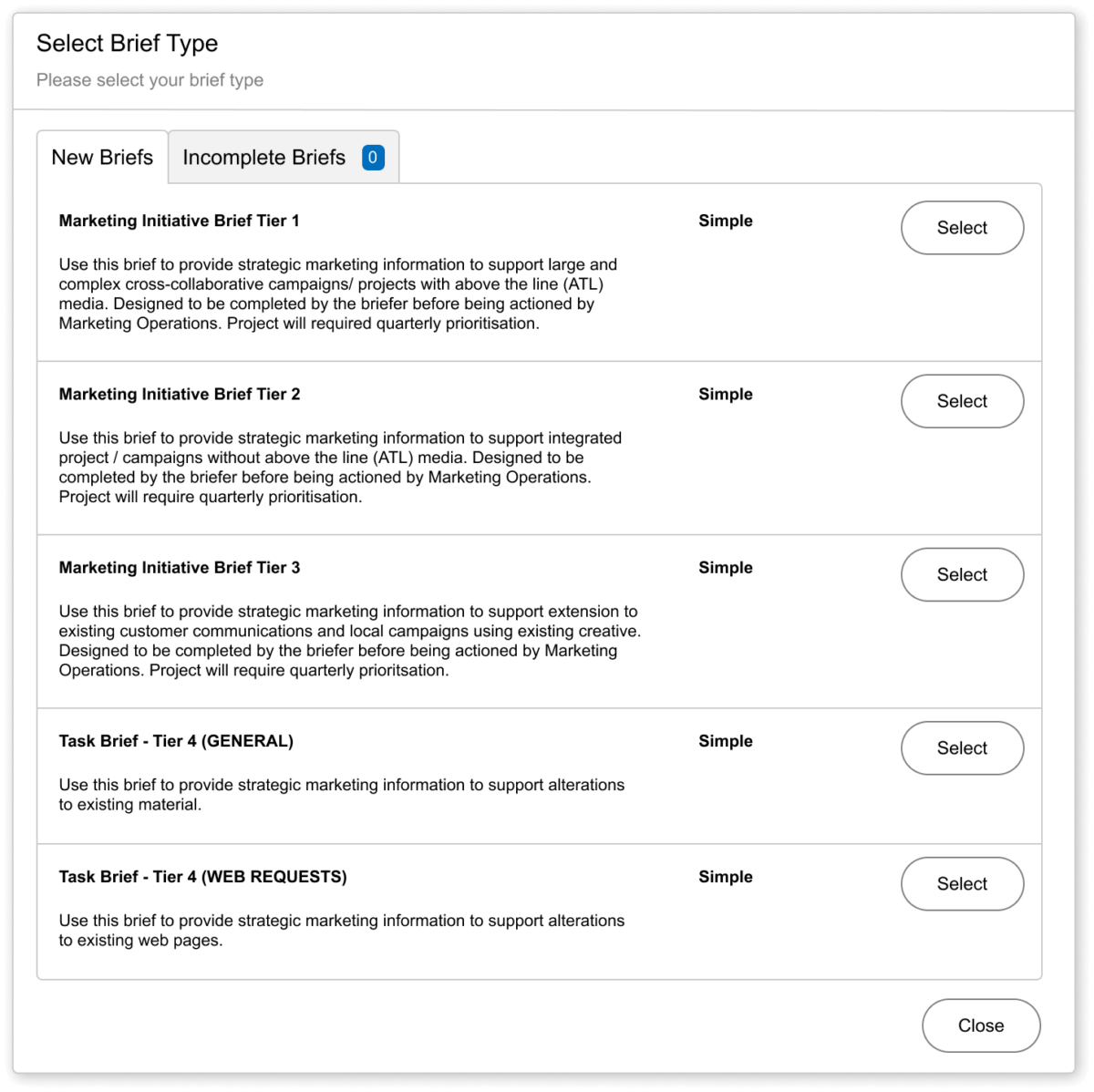
Purpose-built templates for different project types — campaign, content, digital, print, video, social — each capturing the specific information that type of work requires. Mandatory fields prevent a brief from being submitted until all required sections are complete.
Brief approval pathways
Defined routing for brief review — who reviews briefs for each project type, in what order, with what level of authority. Sign-off is captured in the system before work begins.
Version control on briefs
Every change to the brief is tracked. Teams always access the current approved version. Changes after approval are flagged, not silent.
Briefs inside the project record
The brief lives alongside tasks, assets, and approval workflows within the same platform. It stays accessible to every team member throughout the campaign — not abandoned in a folder after kick-off.
Brief duplication for recurring campaigns
Completed briefs can be duplicated for similar projects or recurring content. Fields, compliance requirements, and structure are inherited — eliminating setup time while maintaining consistency.
Compliance requirements attached at brief stage
Regulatory guidelines, compliance frameworks, and disclosure requirements are attached to the brief at initiation — visible to every stakeholder from day one, not discovered in final review.
Further reading: The Role of the Agile Marketing Brief · 4 Ways AI Will Make Creative Briefs Better
When Does Brief Management Software Become Worth It?
Teams running a small volume of simple projects can manage briefs with well-designed templates and disciplined process. The question is at what point the manual approach breaks down consistently enough that the cost of the workaround exceeds the cost of a dedicated system.
The signals that brief management in documents has outgrown the team’s needs:
- Briefs are being reviewed but not approved in any formal sense — there’s no record of who confirmed scope.
- Different team members are working from different versions of the same brief.
- Compliance requirements are being missed at brief stage and discovered in final review.
- Brief templates exist but have diverged across the team, and consistency has eroded.
- The brief lives in a separate document and gets abandoned after kick-off.
- Recurring campaigns require significant setup time to recreate briefs from scratch.
- Brief disputes — about what was agreed, what was in scope, what was mandatory — are a regular source of rework.
When these are consistent problems rather than occasional exceptions, dedicated brief management software starts to pay for itself in reduced revision cycles, avoided compliance risk, and time recovered from brief administration.
Creative Briefs in Regulated Industries
For marketing teams in financial services, insurance, pharmaceutical, or retail, the creative brief is also a compliance document. It’s the point at which regulatory requirements, disclosure obligations, and approval sequences are formally captured — and the point at which gaps become expensive.
Regulated teams need briefs to capture the applicable regulatory frameworks, mandatory disclosures or language requirements, the compliance review sequence, and documentation that compliance signed off on the brief before work began.
When those requirements are part of the brief template — mandatory fields that can’t be skipped — they can’t be overlooked in production. When they live in a separate compliance document or email chain, they frequently are. The cost of a missed compliance requirement discovered in final review is always higher than the cost of capturing it in the brief.
See how Admation supports regulated marketing teams in banking and financial services and health and pharma.
For detail on how Admation supports marketing compliance requirements, see Marketing Compliance Software.
The Brief's Place in the Campaign Workflow
A creative brief doesn’t exist in isolation. It’s the first step in a production workflow that continues through task creation, asset production, creative review, approvals, and final delivery. The quality of the brief affects every stage that follows.
When the brief lives in the same platform as the rest of the workflow, that connection stays visible throughout. Brief fields inform task requirements. Compliance notes from the brief shape the approval pathway. The approved brief is accessible to every team member at every stage — not a document that existed once and can’t now be found.
The workflow sequence looks like this:
- Brief created using structured template →
- Brief routes through defined approval pathway — stakeholder sign-off captured →
- Project and tasks created from brief deliverables →
- Creative assets produced →
- Assets reviewed through online proofing →
- Final approvals captured →
- Files delivered and archived
See how Marketing Project Management Software manages the full campaign workflow from brief to delivery. Or see how Online Proofing Software handles creative review and sign-off once production begins.
Frequently Asked Questions
What is a creative brief?
A creative brief is the foundational alignment document for a creative project. It defines what needs to be produced, why, for whom, by when, and within what constraints — capturing the objectives, audience, deliverables, deadlines, budget, and compliance requirements that a creative team and its stakeholders agree to before work begins. It’s the single source of truth that production decisions are measured against throughout the campaign.
What is the purpose of a creative brief?
The purpose of a creative brief is to align all stakeholders — creative team, client, compliance, and approvers — on what a project needs to achieve before any work starts. A well-constructed brief reduces revision cycles by ensuring the creative team works from complete, approved direction rather than assumptions. It also creates an approval record that holds stakeholders accountable to what they agreed to.
What should be included in a creative brief?
A complete creative brief should include: project purpose and objectives, target audience, key messages and mandatory content, deliverables with format specifications, deadlines and milestones, budget and resource requirements, and compliance or regulatory requirements where applicable. Missing any of these sections creates gaps that typically surface as rework in the middle of production. See how Admation’s brief templates enforce mandatory fields so gaps can’t be submitted.
What is brief management?
Brief management is the system — process, tools, and governance — that ensures creative briefs are complete, approved, version-controlled, and connected to the work they initiate throughout the project lifecycle. Brief management software provides structured templates with mandatory fields, brief approval pathways, version control, and briefs that live inside the project record rather than in separate documents.
What is the difference between a creative brief and a marketing brief?
A marketing brief defines the business context, target market, and marketing objectives for a campaign or initiative. A creative brief translates those into specific creative requirements — what to produce, how it should look and sound, what it must communicate, and what it’s trying to achieve with a specific audience. A creative brief is typically derived from a marketing brief and operates at the execution level. See how marketing project management software connects briefs to the broader campaign workflow.
How does brief approval work?
Brief approval routes a completed brief through a defined review pathway before work begins. Stakeholders — typically a project owner, department head, compliance where required, and client — review the brief and confirm scope, compliance requirements, and resource availability. Feedback is captured directly on the brief. When all reviewers have approved, sign-off is recorded in the system with a timestamp, before the first creative task is assigned. See how Admation’s approval workflow connects brief sign-off to the full campaign approval process.
What is creative brief software?
Creative brief software is a platform for creating, managing, approving, and tracking creative project briefs. It provides structured brief templates with mandatory fields, brief approval workflows to get stakeholder sign-off before work begins, version control, and brief storage inside the project record rather than in separate documents. Brief management software reduces revision cycles by ensuring every project starts with a complete, approved brief. See how Admation’s online proofing connects to brief management as the next step once production begins.
Why do briefs fail?
Most creative briefs fail for one of five reasons: mandatory content is assumed rather than specified; the brief is never formally approved before work begins; version control breaks down and different team members work from different versions; the brief is disconnected from the project and gets abandoned after kick-off; or brief templates have eroded and compliance with required fields is no longer enforced. See how brief management software addresses all five failure points systematically.